Summarize this text with artificial intelligence
Choose your preferred tool to generate a short summary of the text.
Amazon is one of the largest e-commerce platforms reaching millions of customers worldwide. Therefore, it offers an attractive opportunity for entrepreneurs who want to sell with the dropshipping model. However, Amazon imposes certain rules and restrictions to protect the customer experience of sellers. What you need to know when dropshipping on Amazon is not limited to choosing the right product; it also covers account health, supplier selection, customer satisfaction, and shipping processes. In this article, we will discuss the key points to consider when dropshipping in detail.
Amazon Dropshipping Rules and Restrictions
At the core of Amazon’s dropshipping policy is the understanding of protecting the customer experience. The fact that the seller takes responsibility in all processes aims to increase the reliability of the platform. For example, when a customer places an order, they do not care who shipped the product; they see the responsibility directly with the seller because they are shopping through Amazon. Therefore, having another seller's or supplier's information on the package damages customer trust and harms Amazon’s brand integrity.
In addition to this, Amazon recommends that dropshipping sellers make clear agreements with their suppliers. This is because in cases such as the failure to deliver the product on time, wrong shipment, or incomplete packaging, the responsibility is directly placed on the seller. At this point, the seller must manage inventory tracking regularly, work with reliable suppliers, and carry out all customer communication processes through their own brand.
The consequences of non-compliance with policies can also be very severe. Penalties such as account suspension, suspension of sales, and even permanent ban from Amazon are in question. In addition, negative reviews arising from customer dissatisfaction lower the seller's store rating and reduce their visibility in search results. This directly affects sales performance.
Tips for Keeping the Seller Account Safe

Protecting account health when dropshipping on Amazon is of critical importance not only for sales performance but also for the seller to maintain their presence on the platform. Since Amazon’s policies center on customer satisfaction, every factor affecting the account health rating is closely monitored. Late shipment of orders, delivery of incorrect or defective products, customer complaints, and high return rates rapidly lower the seller's account rating. This can pose a risk of account restrictions or complete closure.
To ensure account security, sellers must regularly check performance metrics via the Amazon Seller Central. Indicators such as order defect rate (ODR), late shipment rate, and cancellation rate are of critical importance. If these rates exceed the limits set by Amazon, the seller receives a warning, and in serious cases, selling privileges are suspended.
Another issue that dropshipping sellers should pay attention to is the accuracy of product descriptions and images. Listings that contain misleading or incomplete information for the customer can lead both to negative reviews and penalties resulting from violations of Amazon policies. Besides this, working with reliable suppliers increases customer satisfaction by reducing delays and the risk of incorrect products.
Right Working Strategies with Product Suppliers
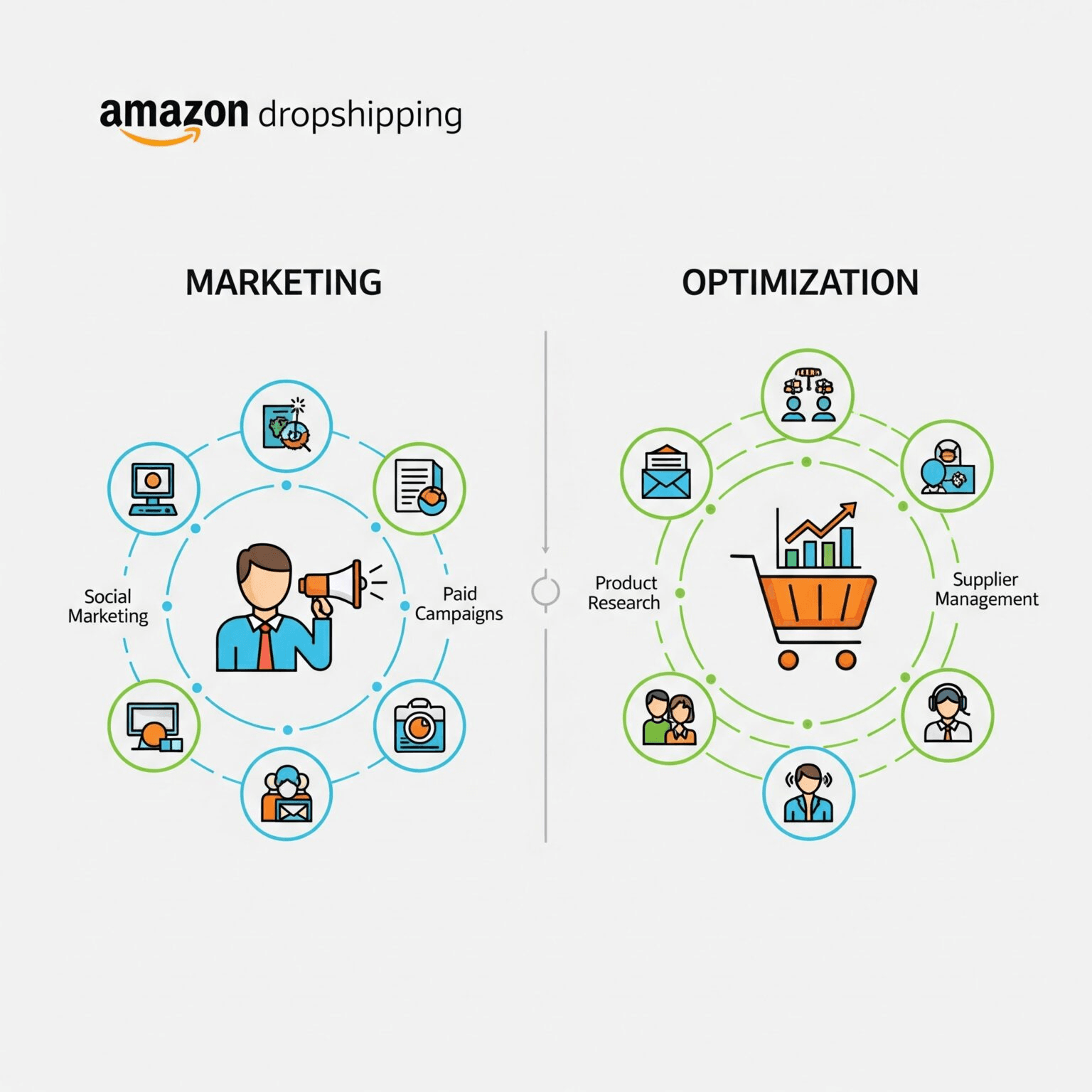
Choosing the right supplier in dropshipping is a critical step not only for operational success but also for long-term brand reliability. The reliability of the supplier the seller works with is directly reflected in the customer experience. Late deliveries, incomplete or incorrect product shipments can risk account health by increasing return rates. Therefore, in the Amazon supplier selection process, sellers must make evaluations focused on quality and service, not just price. The main criteria to consider when choosing a supplier are as follows:
• To meet customer expectations, the supplier must ship orders quickly.
The supplier must provide regular and up-to-date inventory information and should not lead to cancellations due to stockouts.
Sellers should test the supplier's products with sample orders to check quality standards.
Communication established with the supplier must be fast and solution-oriented. A supplier who cannot respond in emergencies can disrupt the seller's business.
It is risky for sellers to rely on just a single supplier. Working with multiple suppliers provides a secure solution against sudden price increases, stockouts, or logistical problems. Thus, the seller can maintain customer satisfaction by continuing uninterrupted product supply.
Amazon Customer Experience Policies

Protecting customer satisfaction on Amazon is of critical importance not only to increase sales but also to secure account health in the long run. Customers share their experiences in the ordering processes through reviews and ratings. These evaluations directly affect the seller's product visibility and sales performance. Negative reviews, on the other hand, both lower algorithmic rankings and damage the trust of potential customers.
On the other hand, Amazon actively measures the speed and quality of communication with the customer. Therefore, it is recommended that sellers respond to incoming messages within 24 hours. Prolonged response time can be negatively reflected in account performance reports. In addition to this, sellers being flexible in return policies increases customer loyalty. Sellers who offer fast solutions gain a long-term advantage by turning customer complaints into satisfaction.
Common Mistakes and Methods of Avoidance

One of the biggest mistakes beginners make is to start listing products directly, ignoring Amazon’s policies. Wrong category selection, incomplete product descriptions, and incorrect pricing reduce the visibility of listings. Therefore, listing optimization tips must be applied to increase sales performance. Another common mistake is relying on only a single supplier. In case of stockouts or price increases, the seller is left in a difficult situation. In addition, being slow in customer communication or not responding to negative reviews also damages store reliability.
Another common mistake that beginner sellers on Amazon make is to ignore account health metrics. Indicators such as late shipment rate, cancellation rate, or customer complaints are closely monitored by Amazon. Negatives experienced in these metrics can go as far as suspension of the seller account. Therefore, sellers must regularly review performance reports and resolve issues quickly.
Brand awareness is one of the most critical elements of making sustainable sales on Amazon. Rather than one-time sales, a strong brand identity that increases the repeat purchase rate provides a long-term advantage to the seller. At this point, sellers must develop a strategy focused not only on the product but also on the brand. For example, sending a special thank you note with each order or using the brand logo in packaging leaves a lasting impression in the customer's mind. In addition, the Brand Registry program offered by Amazon is also an important tool in the branding process. Thanks to this program, sellers can protect their products against counterfeit sellers and access advanced advertising and analysis tools. Thus, both customer trust increases and product visibility is strengthened. Sellers who build a strong brand image in the long run are less affected by price competition and acquire a loyal customer base.
Amazon’s dropshipping policies require sellers to run their business orderly and customer-centric. Prioritizing account security, correct supplier selection, and customer experience are critical elements for long-term success. Beginner sellers need to act by avoiding common mistakes, protecting account health, and paying attention to listing optimization. Entrepreneurs acting with the right strategies can build a lasting and profitable business model when dropshipping on Amazon.