Summarize this text with artificial intelligence
Choose your preferred tool to generate a short summary of the text.
The concept of Etsy SEO is a method used by stores to increase their organic sales by strategically standing out without paying for advertisements on the platform. The Etsy SEO strategies that sellers who want to have a sustainable store must follow mean that you need to regularly optimize your store because it has a dynamic structure.
So, don't you know what to do to make your Etsy store more SEO-friendly? Then good news! In this article, you will get the answers to the following questions:
• What is the working logic of Etsy search results?
• How can you bring your store to the forefront in Etsy search results?
What is Etsy SEO?
Etsy SEO is an optimization process aimed at getting more traffic and sales by ensuring your products and shop appear higher in the search results on the Etsy platform. This process involves optimizing your products, descriptions, keywords, and the overall structure of your shop in accordance with search engine and Etsy algorithms.

How Does the Search Engine Work on Etsy?
Etsy search results work by evaluating many criteria, from your product titles to your tags, from your descriptions to your product photos. Etsy SEO experts generally divide this algorithm into two stages:
• Query matching
• Ranking
So, what do these concepts mean?
• Query matching: When a buyer enters a search term, Etsy checks the matching listings in its inventory.
Ranking, on the other hand, can be considered a much deeper subject than query matching. Etsy generally uses 8 different factors for ranking. Now let's briefly look at these factors.
• Relevance: If tags, titles, categories, and attributes match the user's search query, listings can appear in search results. Exact phrase matches rank higher in search results.
• Listing quality score: The listing quality score is determined by the views and purchase rates of your product. Since the algorithm's working logic is aimed at getting more sales, successful products will have a higher quality score.
• Recency: How new the products are is also among the evaluated criteria. When you add a new product, Etsy makes you more visible in search results for a while. In this way, it determines a quality score for your product.
• Customer and market experience score: Based on your business's customer reviews, how you complete your store's "about" section, and negative reviews, artificial intelligence gives you an experience score.
• Shipping price: As you can guess, one of the most important factors influencing users' purchasing decisions is the shipping price. Etsy prioritizes businesses that offer free shipping or guarantee free shipping, especially to customers in the US.
• Translation and language: All information you enter for your store must be in the language you chose during the creation process. For other languages, Etsy will already help you with the translation.
• Shop location: The location of sellers in the European Union, Australia, and Canada is taken into account, and local products appear slightly higher in search results. In searches made in other countries, the location factor is ignored.
• Shopping habits: Search results are also specially personalized for each buyer. Etsy analyzes customers' past searches and behavior and shows products they are more likely to purchase.
Etsy evaluates listings using a technology called Context Specific Ranking (CSR) for these factors.
CSR helps display relevant listings that are more likely to be purchased, based on the preferences of buyers on Etsy.
Now that you know how Etsy SEO works, we can move on to tips for optimizing and improving your store!

7 Tips to Increase Your Etsy Store's Visibility with SEO
When you optimize your store correctly in 8 different factors, you will notice that both your sales and your visibility increase in a fairly short time. Let's get started now.
1. Choose a Shop Name that Described Your Products
Your shop name is basically the shortest description of your business and briefly tells customers what you sell. For this reason, it is very important to choose the title most relevant to your products.
Your shop name will be the first message welcoming the user. For this reason, you should choose a shop name suitable for your product portfolio.
2. Determine Your Main and Most Important Keywords
The subject of keywords is considered the most important factor of Etsy SEO. Now, first of all, it will be more beneficial for us to understand what keywords do in Etsy and active how they work exactly.
2.1 How do keywords work in Etsy searches?
Before determining keywords, it is important to understand how search results work specifically for words.
Your products must match the search terms used by a user, and search terms closest to the user's search will appear at the top of the search results.
When a customer searches for "authentic rug" on Etsy, the algorithm returns all items that contain both "authentic" and "rug" in their product tags or titles. Then it lists the products in the most relevant way specifically for these keywords.
While Etsy runs this algorithm and lists products according to search terms, it pays particular attention to these points:
Exact phrase match: Exact phrase match is when the user's search term appears directly on your product. Going through the authentic rug search example, "Ottoman authentic rug" is an exact phrase match, while "Authentic Ottoman rug" is a weaker match.
Title and Tag: The algorithm searches for the user's search query in product tags as well as in the title to find as much relevance as possible. Therefore, using the words searched by users in tags for your product will increase your chances.
Keyword Placement in Title: Placing your keyword as far forward in your product title as possible will again put you ahead of your competitors in matching and ranking.
2.2 Find the right keywords for your products
First of all, when determining keywords for your products, you should position yourself as a buyer. In this way, it becomes more possible for you to discover the words that will perform best.
Questions like "What would I write in the search section if I wanted to buy this product?" give you a good starting point. Then, to understand whether your answers are correct, test the keywords you found by typing them into the search bar on Etsy.
Another topic is long-tail keywords. Such keywords have both low competition and a high probability of the searching user purchasing.
An example of a long-tail keyword is "blue square-patterned authentic rug".
When thinking of potential keywords, it will be easy to start from modifiers such as the size or color of your product.
You can consider other search terms a buyer might use in addition to describing your product in terms of what it is, such as:
• Occasion: Users can search for terms on Etsy like "bachelorette party", "wedding accessories", "first anniversary", and "ugly Christmas sweaters".
• Style: Think about how having an aesthetic in your customers' minds affects the way your listing is found. For example, “rustic”, “minimalist”, “nature-inspired”, “art deco”, etc.
• Solution: You must offer a solution to your customers. Consider how a user might search for a way to solve their problems, such as "drawer organizer" or "microchip pet tag", etc.
But we realize that brainstorming this much for each product list would be quite exhausting. That's why there are developed special tools.
Among these tools, Roketfy, a local initiative showing up globally, offers very impressive and accurate results both in finding the keywords your competitors selling similar products to you are listed on, and in discovering how much the words you want to match with your product are displayed in Etsy results.

3. Do Not Use the Same Keyword Over and Over Again
When a user does a search on Etsy, only one or two products from a single seller are shown among the results. Here, maximum level product visibility depends on how closely it matches the user's search.
Etsy calls this factor "declustering." In this way, Etsy ensures that many stores appear in search results.
To be more specific, when you search for "bangles" on Etsy, you will come across many results, as in the screenshot below.
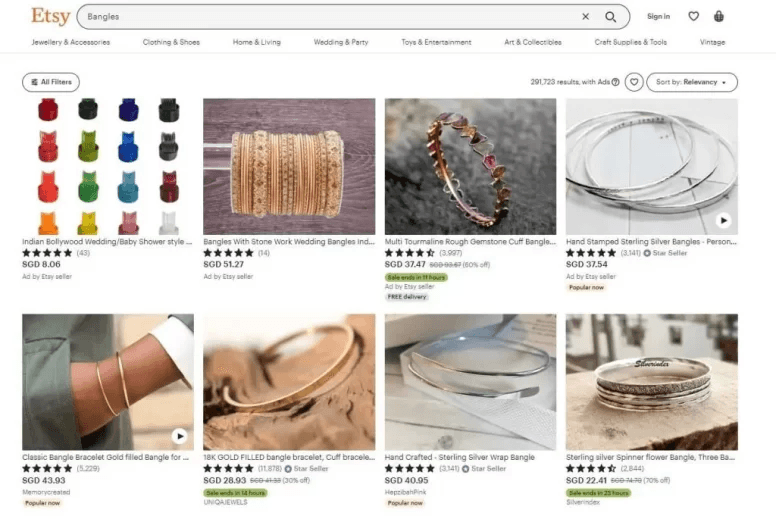
To avoid having a disadvantage in this declustering algorithm on Etsy, you should take care not to use a keyword more than once in your products.
For example, if you sell multiple necklaces in your store, using the term "necklace" for every product you sell is not a good idea. Instead, diversify your keywords after using the word "necklace" a few times.
Position your products around different keywords with more detailed and relevant terms, such as "gold necklace" or "Italian cut silver necklace". This will increase your chances of showing multiple products in search results.
4. Use All Your Tag Rights on Every Product
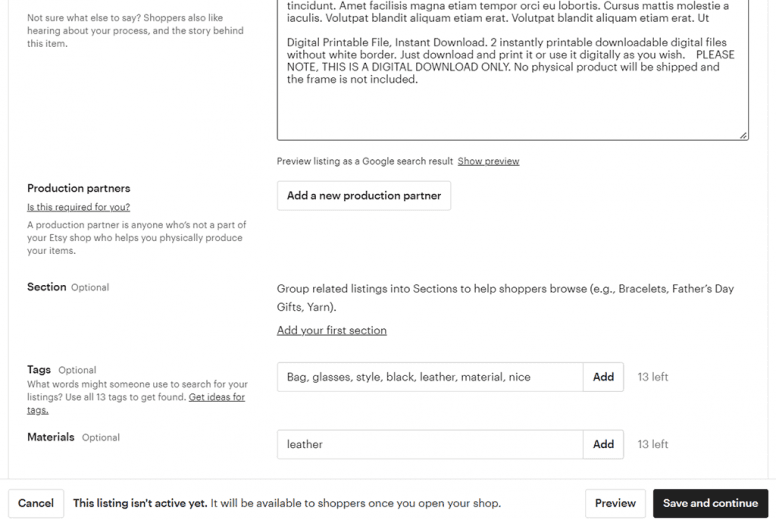
When creating a product, there are many fields you need to fill in, such as title, category, and description. These fields are already marked as mandatory by Etsy on the panel with (*). Especially the fields marked with stars are points that the algorithm directly pays attention to.
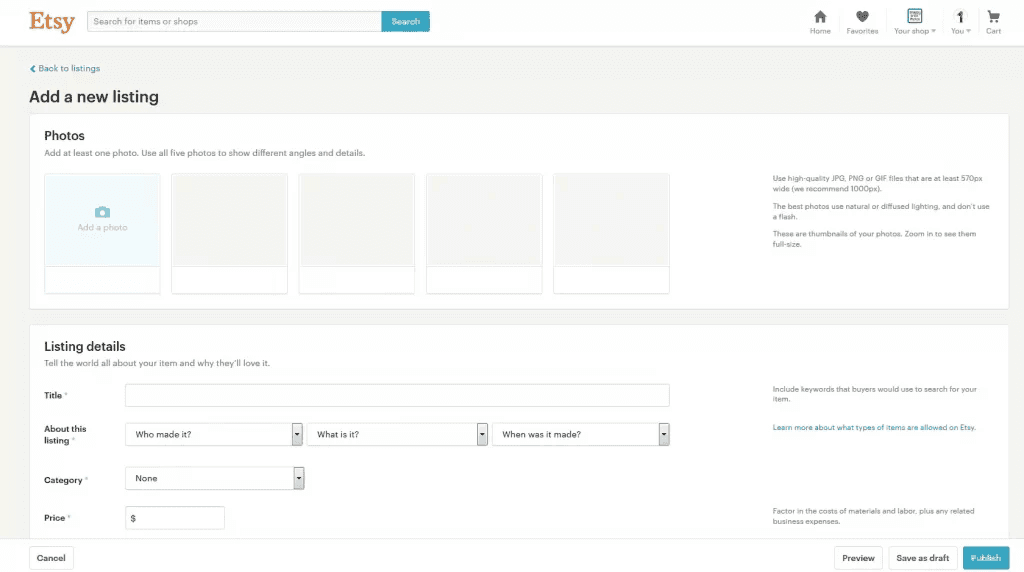
The tags field is shown optionally. It is very important to provide a variety of tags to optimize your products for search. You can use a maximum of 13 tags for each product on Etsy. At this point, you can take your visibility to an even better place by using all your rights.
At this stage, adding synonyms of your product among your tags while entering tags will be a good signal for the algorithm.
It will be very beneficial for you to generally pay attention to the following points when entering tags:
• Tags should not be repeated: You should evaluate your 13 rights not around the same words, but with as diverse words as possible.
• If there is already a tag in the attributes, do not use it: If you have already specified that you sell red and gold vintage earrings, you do not need to add a tag for "red and gold vintage earrings".
• Tags should not contain plurals or typos: When a user enters a query, Etsy scans root words and frequently guides users who make typos to the correct spelling of the word.
• Adding tags in several languages is not a good idea: Only use the language you chose when creating your store. Etsy will help you translate your listings.
5. Start with Keywords on Your Products
When creating a new product, start with the most important information about your store or item, on other words, the keywords you want to rank for. This situation will both attract the user's attention and increase relevance.
When putting the details of your product on the product page, you can pay attention to the following topics about adding the most important features of your item to the first few words:
• Item title: At the very beginning of the product title, clearly describe the product and include the most relevant keyword a buyer would use to search for it.
• Item description: You can use the first 160 characters of your item description to create the meta description of your listing page. This is the text that appears under your page title in search engine results. Although your description may be longer than 160 characters, the first 40 characters should contain the most important keywords for your product.
• Shop sections: You can create a maximum of 20 custom sections in your shop, and each has its own landing page. A page title based on the section name will be used for each landing page.
These page titles, like your shop title, are what a user will see on a search engine when they click a link to your shop. The name of a section can be up to 24 characters long.

6. Update Your Products Regularly
Recency is a factor in Etsy's search algorithm when you create a new product, and it works quite effectively. Etsy tracks and records how customers interact with shops and products.
Then it uses this information to evaluate the quality score of products. At the same time, updated products also receive a similar boost, directly testing your products by placing them at the forefront on Etsy for a while.
Warning: Renewing or re-listing your products regularly is not an effective Etsy SEO strategy; renewing listings at specific times can be beneficial.
For example, in a scenario where you optimize one or more keywords for your product, using this method to strengthen your product's SEO will provide additional benefits. However, at this point, preferring the hours when users are more active on Etsy will be more effective in increasing sales.
7. Maximize Customer Experience
Etsy's goal is to provide its users with the maximum level of good shopping experience. For this reason, it evaluates a store's interaction and quality with its customers. Stores that offer a good experience come to the forefront more.
At this point, creating a strategy by analyzing the customer experience of both your store and competitor stores will make you stand out. Using the Roketfy review analysis module for this will benefit you in determining strategies.
To verify that your store complies with the quality standards set by Etsy, you must complete all requested information thoroughly. About me, shipping, payment options, returns and exchanges, and privacy sections must be in your store.
In addition to this, your relationship with your customers is also directly related to your SEO visibility on Etsy. For example, offering a shipment tracking number in Etsy shipping, managing return processes, and providing quick responses to all kinds of positive/negative reviews and questions from users will make you a higher quality store in Etsy's eyes.
Final Words - Optimize Your Etsy Store's SEO Regularly
As the number of products in your Etsy store expands, making edits through manual checks can become challenging. However, in order to sustain the organic sales of your store, you must also actively continue to improve your SEO.
For this, you can continue to automatically optimize by regularly checking your store and products from Roketfy. So, on which subjects will it help you?
• Keyword analysis
• Listing analysis
• AI-powered product description writing
• Review analysis
• Product research
Remember that organic sales come through data analysis. If you update your store regularly according to data, it is impossible for your sales not to reach the top on Etsy!