Summarize this text with artificial intelligence
Choose your preferred tool to generate a short summary of the text.
August 2026 Logistics Industry Newsletter: 8 Highlighted Developments
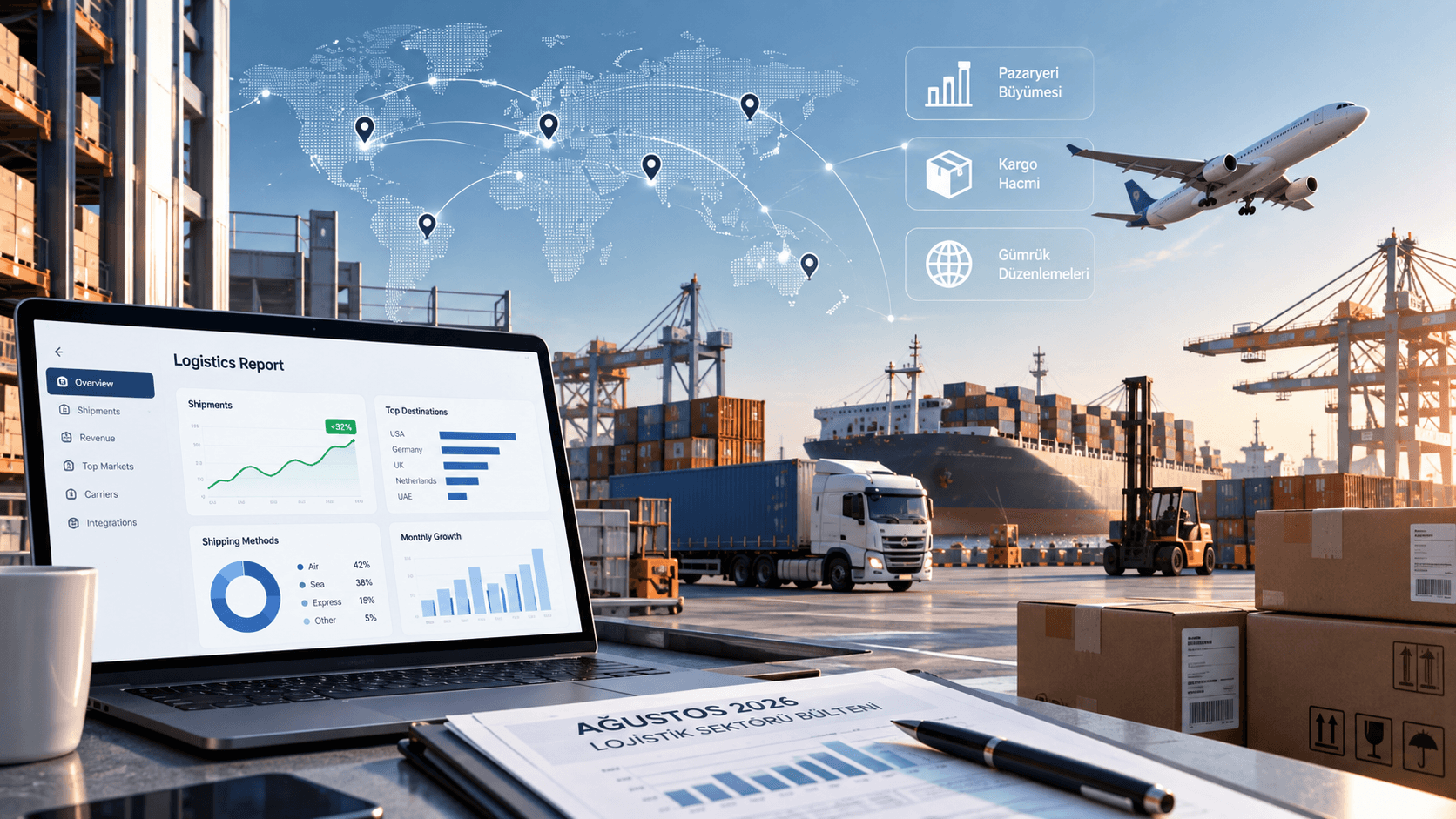
The August 2026 logistics industry newsletter gathers eight developments in cross-border e-commerce, customs regulations, marketplace integrations, and warehousing. The growth in cross-border volume, signals of change in US customs practices, and the increase in fulfillment demand are reshaping businesses' transport strategies. This newsletter covers current developments and the unchanging core dynamics of the industry under separate headings.
Brief summary:
Cross-border e-commerce: International online shopping volume continues to grow in 2026, leading businesses to multi-channel shipping solutions.
Customs regulations: Customs duty practices in the US and European markets directly affect shipping processes and delivery times.
Marketplace integration: Businesses selling on Amazon, eBay, and Etsy are turning to automating their shipping processes.
Warehousing and fulfillment: Overseas warehousing demand is increasing; businesses prefer to keep their stocks close to target markets.
Price comparison: Platforms like Navlungo offer instant quote comparison to more than 130 countries.
Table of Contents
1. Factors driving this change
2. 8 developments that stand out in August 2026
1. Cross-border e-commerce volume continues to grow
2. Signals of change in US customs regulations
3. Marketplace integrations come to the fore
4. Demand for warehousing and fulfillment increases
5. Last mile delivery costs are being optimized
6. Sustainability reporting on the agenda
7. Transport price comparison platforms are becoming widespread
8. Supply chain diversification gains momentum
3. Data and signals: the pulse of the industry
4. Impact by industry segments
1. E-commerce businesses
2. Manufacturers and exporters
3. Marketplace sellers
4. Logistics service providers
5. What to expect in the coming period
6. Unchanging fundamentals in the logistics industry
7. Frequently asked questions
Factors driving this change
Behind the logistics developments in August 2026 are three main factors: the growth of cross-border e-commerce, mobility in customs legislation, and the increase in operational demands of marketplace sellers. Cross-border e-commerce describes the process of directly selling a product manufactured in one country to a buyer in another country, and as this volume grows, competition in price and delivery times among shipping companies intensifies.
Customs practices in major trading partners like the US, Germany, and China directly determine shipping costs. A business cannot price its products when shipping to America without knowing the current tax rate; therefore, interest in tools like Calculate US Customs Duty is increasing. At the same time, businesses selling through Amazon, eBay, and Etsy are turning to panels where they can receive automatic shipping quotes as soon as an order is placed.
8 developments that stand out in August 2026
This section lists eight developments observed in the logistics industry as of August 2026. Each heading summarizes a current trend and its practical outcome for businesses.
1. Cross-border e-commerce volume continues to grow
The number of Turkish businesses selling in international marketplaces is on the rise. This growth directly drives demand upward on America Shipping, European shipping lines, and China Shipping routes. Instead of being tied to a single carrier, businesses now prefer to ship by comparing different service levels.
2. Signals of change in US customs regulations
Exporters shipping to the US market place more importance on the predictability of the customs duty calculation process. Customs duty is the official tax paid for a product imported into a country, and its amount varies according to product category, value, and country of origin. Therefore, calculating taxes prior to shipment is becoming the most practical way to prevent pricing errors.
3. Marketplace integrations come to the fore
Businesses managing Amazon International Shipping, eBay International Shipping, and Etsy International Shipping processes prefer to connect their stores directly to the logistics panel. The approach of receiving automatic quotes as soon as an order arrives is replacing manual shipment tracking. This integration saves time, especially for sellers shipping large numbers of small packages.
4. Demand for warehousing and fulfillment increases
Warehousing close to the target market is a method that shortens delivery times and reduces return costs. Fulfillment refers to the entire operation, from order receipt to packaging and shipping, being carried out by a service provider. The shift of e-exporting businesses towards this model shifts inventory management away from the center and closer to the market.
5. Last mile delivery costs are being optimized
Last mile delivery defines the final stage of the product from the distribution center to the recipient's door and usually constitutes the largest part of transportation costs. Carriers are investing in route optimization and regional warehouse networks to lower this cost. For businesses, this creates an opportunity to strike a clearer balance between delivery time and price.
6. Sustainability reporting on the agenda
Major carriers are taking steps towards offering shipment-based carbon footprint reporting. This data is not yet presented in a standard format, but it is observed that businesses have started to evaluate it as a criterion in carrier selection. Moreover, this trend is gaining importance especially for exporters shipping to the European market.
7. Transport price comparison platforms are becoming widespread
Logistics platforms that operate on a flight ticket comparison logic allow businesses to see hundreds of carrier options from a single screen. Navlungo implements this model by offering shipping quotes to more than 130 countries. Businesses can choose the one suitable for their budget from eco, express, and other service options.
8. Supply chain diversification gains momentum
Instead of depending on a single manufacturing or supply country, businesses are establishing alternative supplier and carrier relationships on different routes such as China, Germany, and America. This diversification aims to prevent a single customs or transportation crisis from stopping the entire operation. There is no common standard across the industry yet, but the orientation is towards this direction.
Data and signals: the pulse of the industry
As of August 2026, signals in the industry indicate that volume growth is moving forward hand in hand with price competition. The following points are concrete indicators observed during this period:
Instant shipping quotes can be obtained for more than 130 countries through platforms like Navlungo.
Demand for Amazon, eBay, and Etsy integrations is on a rising trend among marketplace sellers.
The frequency of using customs duty calculation tools is increasing among businesses shipping to the US.
Major carriers like DHL International Shipping and FedEx International Shipping appear more frequently in price comparison panels.
Warehousing and fulfillment demand is on an upward trend, especially for businesses shipping to the German and US markets.
These data show the general trend; exact rates may vary from carrier to carrier and market to market.
Impact by industry segments
Developments in August 2026 do not affect every business type in the same way. The impact differs by segment.
E-commerce businesses
For multi-channel selling e-commerce businesses, the biggest change is happening in the store integration and automatic quote retrieval process. As order volume increases, manual shipping management ceases to be sustainable. These businesses can now compare quotes on the panel and ship directly.
Manufacturers and exporters
For manufacturers and exporters, the real issue is making e-export logistics processes predictable on the customs and tax side. Instead of being tied to a fixed carrier, trying different routes for different countries provides a cost advantage. This flexibility is more visible on routes like Germany Shipping and America Shipping.
Marketplace sellers
For small-scale sellers who sell through Amazon, eBay, and Etsy, the speed of integration is decisive. Sellers who can receive automatic quotes as soon as an order is placed save time compared to those who run manual processes. This difference grows even larger with high order volumes.
Logistics service providers
For carriers, competition is turning into gaining visibility on price comparison platforms. A carrier being listed on the panel can generate more orders than direct marketing. This directs carriers towards platform partnerships.
What to expect in the coming period
The assessments in this section are speculative and do not contain precise dates or rates. Should cross-border e-commerce volumes continue to grow, demand for marketplace integrations can also be expected to increase. If potential changes in customs regulations occur, the frequency of businesses utilizing tax calculation tools could rise. It is also a likely direction for sustainability reporting to become a more visible criterion in carrier selection. However, when this will become standard remains uncertain at present.
Unchanging fundamentals in the logistics industry
Underneath these changes lie some core dynamics that are independent of time. International shipping always relies on three elements: shipping cost, delivery time, and customs compliance. A business cannot establish a sustainable export operation without balancing these three elements.
The concept of customs duty also does not change: a product entering a country is taxed at the rate determined by that country, and this rate varies according to the product category. Likewise, the warehousing and fulfillment model is based on the logic of keeping stock close to the buyer, and this logic remains the same even if technology changes. The quote comparison approach offered by Navlungo also stems from this basic need: allowing businesses to choose the one suitable for them from hundreds of carriers.
Frequently asked questions
What topics does the August 2026 logistics newsletter cover?
The newsletter covers eight developments: cross-border e-commerce, customs regulations, marketplace integrations, warehousing, last mile delivery, sustainability reporting, price comparison platforms, and supply chain diversification. These headings reflect the trends observed as of August 2026. Exact rates vary by carrier and market.
How is customs duty calculated?
Customs duty is determined based on the product's category, customs value, and country of origin, and these variables differ from country to country. Businesses shipping to the US can see the estimated tax amount prior to shipping with the Calculate US Customs Duty tool. This calculation helps determine the projected amount, not the final amount.
How does marketplace integration change the shipping process?
Store integration allows automatic shipping quotes to be obtained as soon as an order is placed and reduces the need for manual tracking. For sellers managing Amazon International Shipping, eBay International Shipping, and Etsy International Shipping processes, this means time savings. Integration makes a larger difference for sellers with high order volumes.
Who needs warehousing and fulfillment services?
Fulfillment services are a meaningful option for exporters who want to keep stock close to the target market, shorten delivery times, and lower return costs. This model involves outsourcing the entire process, from order receipt to packaging and shipping, to a service provider. It also offers a scalable option for small-volume sellers.
How fast can the developments in August 2026 change?
Time-sensitive elements like customs regulations and price competition can change quickly, so current developments in the newsletter should be updated periodically. Core dynamics such as shipping cost, delivery time, and customs compliance are more permanent. This distinction determines how often businesses need to look at what information.
Which countries does Navlungo ship to?
Navlungo offers instant shipping quote comparison to more than 130 countries and serves routes such as America, Germany, the UK, France, Australia, and the United Arab Emirates. Businesses can choose from eco, express, and other service options through the panel. A US-specific customs duty calculation tool prior to shipping is also available on the same panel.