Summarize this text with artificial intelligence
Choose your preferred tool to generate a short summary of the text.
A Certificate of Origin (Menşe Şahadetnamesi) is a document used in cross-border trade transactions regarding the origin status of the goods. This document provides official documentation of the country in which the goods were produced or processed in trade transactions between countries.
The Certificate of Origin plays an important role concerning customs duties, tariffs, and other legal obligations of the goods, supporting the smooth and legal execution of commercial transactions. By reading the rest of the article, you can find the answers to all the questions you have about the Certificate of Origin.
What is a Certificate of Origin? What are Its General Characteristics?
The question of what a Certificate of Origin is is frequently asked by importers and exporters. This document, alternatively referred to as the Certificate of Origin, is a document showing the origin of the exported goods.
Exporters can easily obtain approval for the relevant trade document by applying to the Chambers of Commerce. There are two types of documents issued by the Chambers. Preferential and non-preferential origin are the types of the relevant document.
The Certificate of Origin actually determines whether the transported goods are legal. Whether the goods subject to export/import are subject to tax is also clear thanks to the relevant document.
Almost all countries act by considering the origin of the relevant products to understand whether the goods they import are legal. The relevant document only helps to prove the origin of the products to meet customs or commercial needs.

Importance of the Certificate of Origin: Why Is It Used and What Is It For?
The Certificate of Origin is a highly important document. In international trade practices, the relevant document must be presented by the exporter company. The country in which the relevant product was produced is proven by this document.
In addition, the destination of the relevant goods and the country of export are also determined by this document. When cross-border trade is under consideration, the importance of the Certificate of Origin can also be mentioned for various agreements. The extent to which the relevant goods are suitable for implementation and the level of tax they will be subjected to are determined by the Certificate of Origin.
Operations such as concessions, quotas, customs duties, and anti-dumping regarding imported products can be easily checked through the origin of the products. By examining the shipment-specific Certificate of Origin, the customs administration also verifies the tax rates in line with the trade to be conducted with the country.
Furthermore, although misunderstood about the document; the origin represents the country, not the point where the goods were shipped. The production of a good in two or more countries leads to the acceptance of the origin as the country to which more than half of the production cost of the relevant goods belongs.
When all information is gathered, the points where the origin of a product is important can be listed as follows;
• Calculation of customs duties to be collected from the import transaction,
• Keeping foreign trade statistical records accurately and completely,
• Implementation of trade policy measures
Many foreign trade activities are carried out based on the country of origin of the goods in question. Likewise, this document ensures that foreign trade law between countries runs without interruption.

How Is a Certificate of Origin Prepared? What Information Should It Contain?
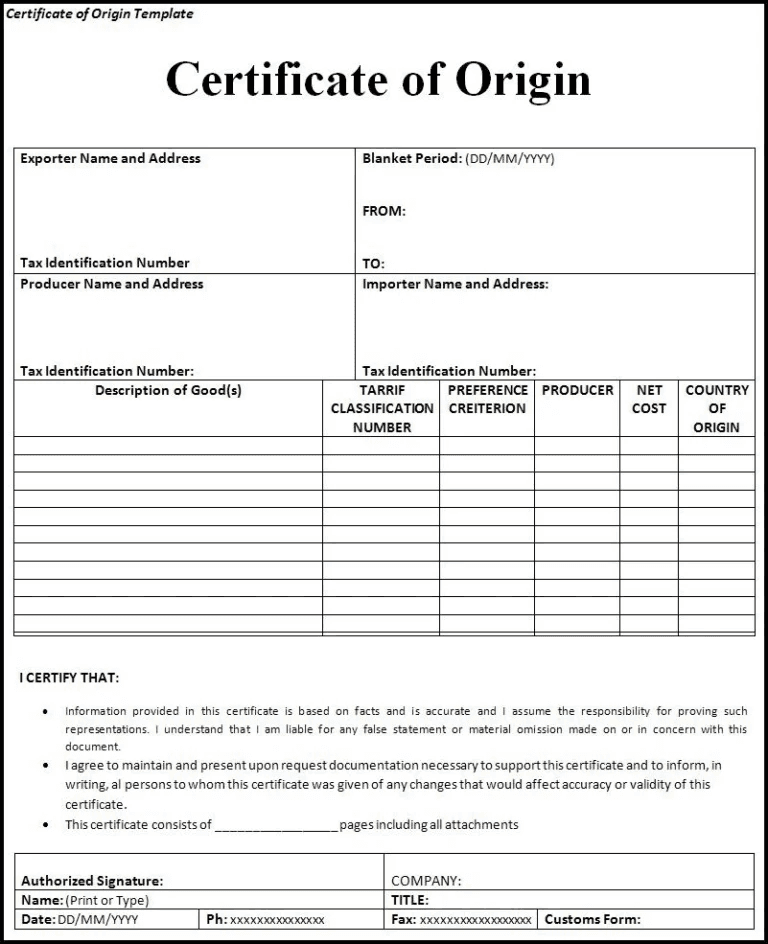
When preparing a Certificate of Origin, some regulations must be taken into account. We have complied the information required to be included in the relevant document for you;
• The name and surname of the person sending the relevant product. The information in this field is also valid for institutions, organizations, and countries.
• Name and surname information of the institution, person, or organization that the product mentioned in the document will reach within the borders of Turkey,
• Information such as the type, net, and gross weight of the product,
• The signature and seal indicating that the competent authority issuing the Certificate of Origin has approved the document,
• Detailed and orderly information regarding the number, mark, and count of the packages,
• The value of the product and information on the methods through which the same product will be sent,
• If the goods in question have undergone modifications in that country, a detailed description of the modifications made.
All the information mentioned above must be submitted accurately and completely. If all information about the goods in question is not provided, numerous issues may arise. In some cases, proof may be requested from the sending country.

Types of Certificates of Origin: Which Type of Certificate Is Used in Which Situations?
There are two types of Certificates of Origin. Preferential and Non-Preferential Origin forms can be detailed as follows:
• Non-Preferential Origin: The relevant document is used when no tariff treatment is applied to the goods subject to export or import and when taxes must be collected on the transported product. The non-preferential Certificate of Origin is used only to state that the transported products originate from a certain country.
• Preferential Origin: In this type of document, a preferential tariff is applied to the products during the payment of taxes. The taxes mentioned may include normal tariff reductions as well as total exemptions from tariffs. In this type of origin, certain exemptions apply when goods between two or more countries are exported or imported.
To find the correct answer to questions such as how to obtain a Certificate of Origin, you must first decide which type of document you need to prepare. How to obtain the document is also a separate informative topic.
To have this document issued by chambers of industry upon application, you must also apply to the relevant chamber of industry. You can get help from the Navlungo team to find out clear information on whether you need this document before sending your products abroad.

Procedures Related to the Certificate of Origin: What Documents Are Required?
After answering questions like who issues the Certificate of Origin and where to request it, it is worth mentioning what documents are requested. A commercial invoice in Turkish is requested for the Certificate of Origin.
This invoice must be approved by the Ministry of Finance and certified by a Notary. For products not of Turkish origin, a document showing the origin is also required. This is a photocopy of the Customs Entry Declaration. Alternatively, a Certificate of Origin Promoting document can also be used.
Certificate of Origin and International Trade: In Which Situations Is It Necessary to Issue a Certificate?
You might be wondering who issues the Certificate of Origin and in which situations it is necessary to issue it. First of all, it is worth reminding that not every country requests the document in question. However, if the relevant country has a Proof of Origin document requirement, the document in question must be prepared by the importer and their representative.

Certificate of Origin and the Export Process: What Is the Process of Issuing a Certificate and What Points Must Be Considered?
The Certificate of Origin is an important document required during the export process of a product. In the export process, issuing and correctly preparing the certificate of origin ensures that the exporter is accurately informed about the customs duties, tariffs, and other legal obligations of their product, and that the export process is executed smoothly and legally. The points that exporters must consider when issuing a certificate of origin can be listed as follows:
• Providing accurate information about the product
• Preparing the certificate of origin in accordance with the legal processes of the country of origin
• Having other documents required for the export process ready (invoice, delivery note, transport contract, etc.).
The Certificate of Origin ensures the fulfillment of legal obligations in the export process and correct information regarding customs duties, tariffs, and other legal obligations of the product. Therefore, the process of issuing a certificate of origin and the points to be considered play an important role for exporters and ensure that the export process is conducted in a smooth and legal manner.
Government policies of each country are different from each other. Depending on unilateral and bilateral agreements between countries, specified goods from target countries may from time to time be exempt from import taxes. Therefore, the Certificate of Origin plays a vital role in international trade processes between countries. You can benefit from the professional support of Navlungo to manage your processes accurately.